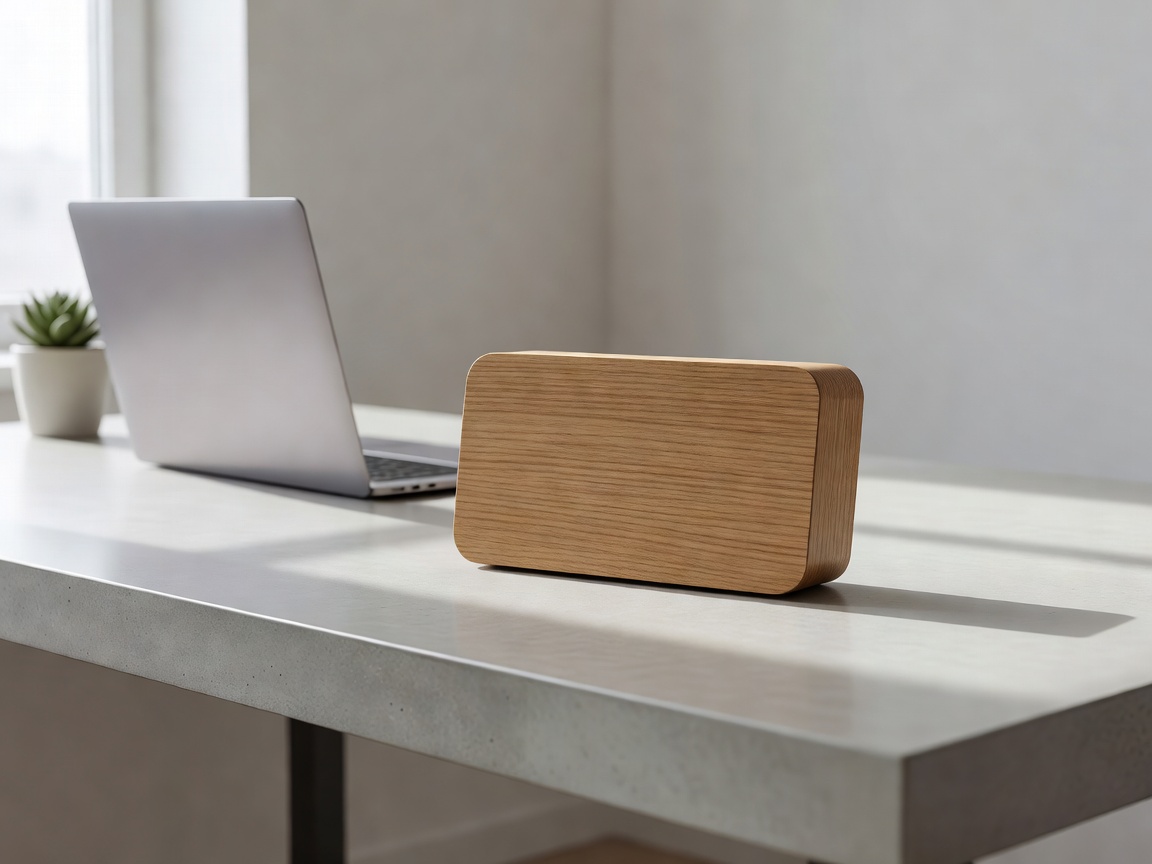
In contemporary workspace design, the digital clock serves as a grounding visual anchor. While computer operating systems prominently display the time, turning one's head away from the glow of a monitor to check an independent device provides necessary eye relief and breaks visual monotony. Thus, the aesthetic of the desk clock matters profoundly.
The Minimalist Movement
Industrial design over the last decade has aggressively pursued minimalism, stripping away extraneous buttons, bezels, and branding. The "wood block" digital clock is a prime example of this trend. By embedding a hidden LED array behind a thin veneer of real or synthetic wood, the device appears as a solid block of timber until powered on, at which point the light bleeds through the grain to form digits.
This approach effectively removes the concept of the "screen" from the desk entirely, reducing technological clutter while maintaining digital utility.
Typographic Considerations
The legibility and personality of a digital clock are defined by its typography. High-end modern units often step away from the rigid, segmented styling of the 1980s in favor of fluid, continuous-line numeric displays or high-resolution dot-matrix grids. The spacing (kerning) between hours and minutes, the weight of the font, and the color temperature of the illumination all contribute to the psychological impact of the device.
Warm amber and soft white illuminations are currently preferred over stark blues and aggressive reds, as warmer light temperatures induce less cognitive fatigue during extended work sessions.
Ergonomics and Placement
A strictly aesthetic clock fails if it ignores ergonomics. The viewing angle of the desk clock dictates its physical structure. A unit designed to sit flat on a desk must have its face angled upward at approximately 15 to 20 degrees to meet the eyeline of a seated user without requiring them to hunch over.
Additionally, cord management is a critical facet of modern aesthetic design. Premium models utilize recessed USB-C ports and right-angle cables to ensure that power delivery remains invisible from the user's perspective, preserving the illusion of a standalone object.
Multifunctionality
Space on a modern desk is premium real estate. To justify their footprint, many aesthetic desk clocks incorporate secondary, passive features. The most successful implementation of this is the integration of wireless charging coils into the top plane of the clock. Users can place their smartphones or wireless earbuds on top of the clock structure to charge, turning the timepiece into a functional pedestal.
Conclusion
The modern digital desk clock is a study in material science, typography, and spatial efficiency. By prioritizing clean lines, warm illumination, and multi-functional footprints, designers continue to prove that even the most ubiquitous technology deserves a thoughtful physical presence.