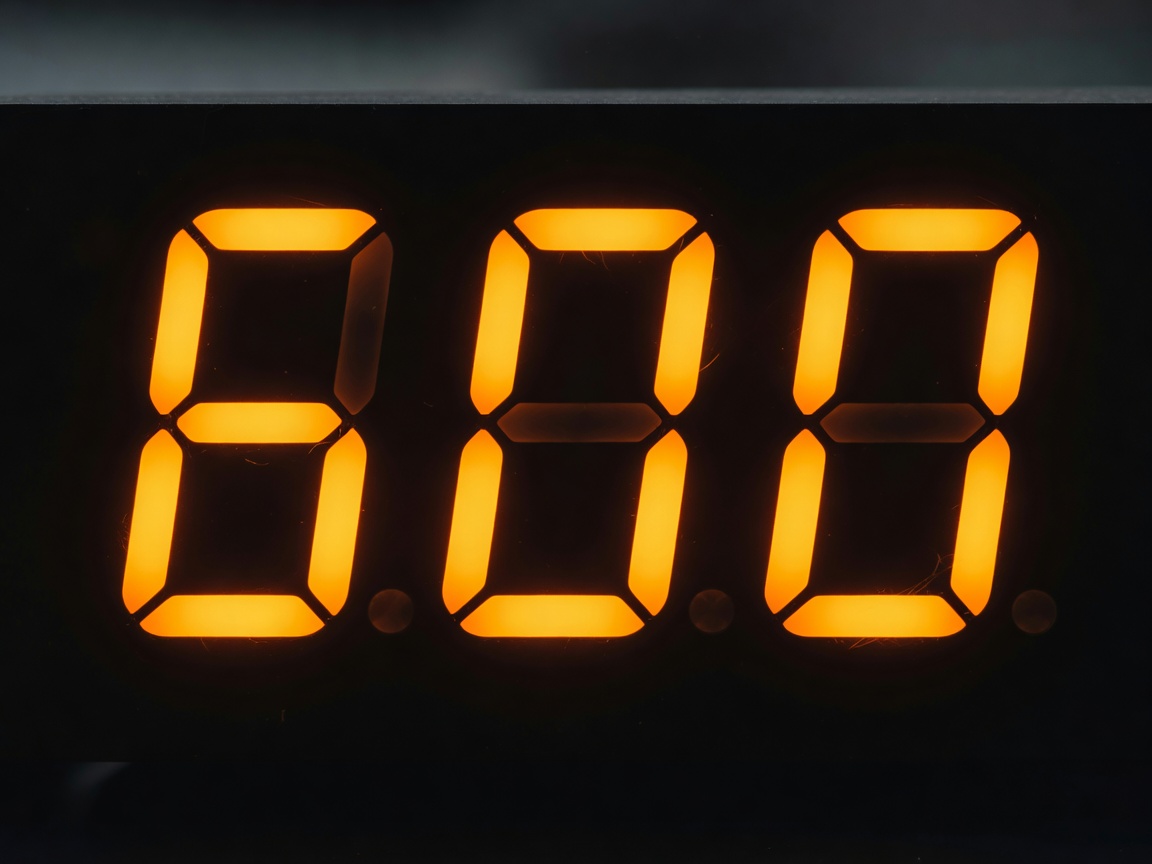
The interface of any digital clock is its display module. For decades, the industry has relied on two primary technologies: Light Emitting Diodes (LED) and Liquid Crystal Displays (LCD). While modern variations exist, the foundational choice between these two formats will dictate the contrast, viewing angle limits, and power requirements of the device.
LED Technology & Characteristics
An LED display is comprised of individual diodes that emit light when an electrical current passes through them. In a standard digital clock, these diodes are arranged in a "seven-segment" configuration to form numbers. Because the digits themselves generate the light, the surrounding background remains completely unlit (assuming a black faceplate).
Benefits: The primary advantage of an LED clock is its infinite contrast ratio in a dark room. The numbers glow intensely, making them highly visible from extreme distances and wide angles. They do not suffer from the "ghosting" effects seen on older displays, and their lifespan typically exceeds 50,000 hours of continuous operation.
LCD Technology & Characteristics
Liquid Crystal Displays do not emit their own light. Instead, they use a layer of liquid crystals trapped between two polarized filters. Applying an electrical current alters the crystal structure, blocking ambient light from passing through and creating dark segments on a lighter background.
Benefits: Because they only manipulate ambient light rather than generating it, standard LCDs are incredibly power efficient. A digital clock utilizing a basic LCD can run for multiple years on a single set of AA batteries. To resolve visibility issues in dark environments, many LCD clocks include a small internal backlight that can be activated via a button press or ambient light sensor.
Performance Comparison Matrix
| Specification | Standard LED | Standard LCD |
|---|---|---|
| Power Draw | High (requires continuous AC power) | Extremely Low (battery operated) |
| Contrast (Daylight) | Good (can wash out in direct sun) | Excellent (relies on ambient light) |
| Contrast (Darkness) | Excellent (emissive) | Poor (requires secondary backlight) |
| Viewing Angle | Wide (up to 160 degrees) | Narrow (subject to phase inversion) |
Viewing Angles and Phase Inversion
A critical limitation of traditional LCD technology is phase inversion. If you view an LCD clock from a sharp vertical or horizontal angle, the contrast can suddenly invert—dark segments become light, and the background darkens, rendering the time unreadable. LED displays, being emissive, maintain their legibility and color accuracy regardless of the angle of observation.
The Verdict
The choice is strictly utilitarian. If the clock must be read across a dark room, or if maximum visual punch is desired, an LED unit plugged into a wall outlet is vastly superior. If the clock needs to be portable, placed on a desk without cable clutter, or highly readable in bright sunlight, an LCD unit is the optimal engineering choice.